
From Freelance to Full-Time: Navigating the Permanent Hire Journey for Senior Engineers
Understanding the paradigm shift, mastering the multi-stage interview process, and turning 20 years of independent work into your greatest advantage


The Two-Decade Freelancer’s Dilemma: Why Your Next Interview Isn’t Just Another Gig
For twenty years, you’ve been the master of your own destiny. As a full-stack freelance engineer, you’ve parachuted into countless projects, solved complex problems, and delivered results with the swift efficiency that only a seasoned independent contractor can muster. Your interviews were typically a brisk, 60-minute affair—a focused evaluation of your technical prowess, a quick negotiation of contract terms, and then you’re off to the races. You are a known quantity, a reliable expert for hire.
But now, at 44, you’re contemplating a different path: a permanent, full-time role. And you’ve discovered the rules of the game have changed entirely. The multi-stage, marathon interview process feels foreign, almost labyrinthine, compared to the transactional nature of contract work. You’re not just being evaluated for a specific task anymore; you’re being assessed as a long-term investment, a cultural addition, and a future leader within an organization.
This transition is becoming increasingly common. The freelance economy is booming, with independent professionals collectively generating $1.5 trillion in earnings in 2024. Many seasoned freelancers eventually seek the stability, collaborative environment, and long-term impact of a permanent position. Full-time roles offer opportunities to see projects through from inception to scale, to mentor junior engineers over years instead of weeks, and to engrain yourself in a product and team that you truly believe in. It’s a different kind of reward—one measured in growth and legacy rather than just invoice payments.
Here’s the challenge: You must reframe your extensive freelance experience for a full-time hiring mindset. This guide is your roadmap. It’s designed to help you—an experienced freelance engineer—navigate this complex transition, understand the fundamental shift in how companies hire for permanent roles, and strategically position your two decades of independent work as your most powerful asset in landing that full-time position.
The Paradigm Shift: From 60-Minute Transaction to 8-Hour Evaluation
The most significant hurdle for a long-term freelancer is understanding the profound difference in what companies look for during full-time hiring. Freelance hiring is a transactional process optimized for speed and immediate skill validation. In contrast, permanent hiring is a relational process designed to mitigate risk and build a sustainable, cohesive team for the long run. This isn’t just rhetoric—a stark contrast to the single-meeting freelance model [2], tech companies truly have a multi-stage interview process that can span several weeks, involving numerous stakeholders.
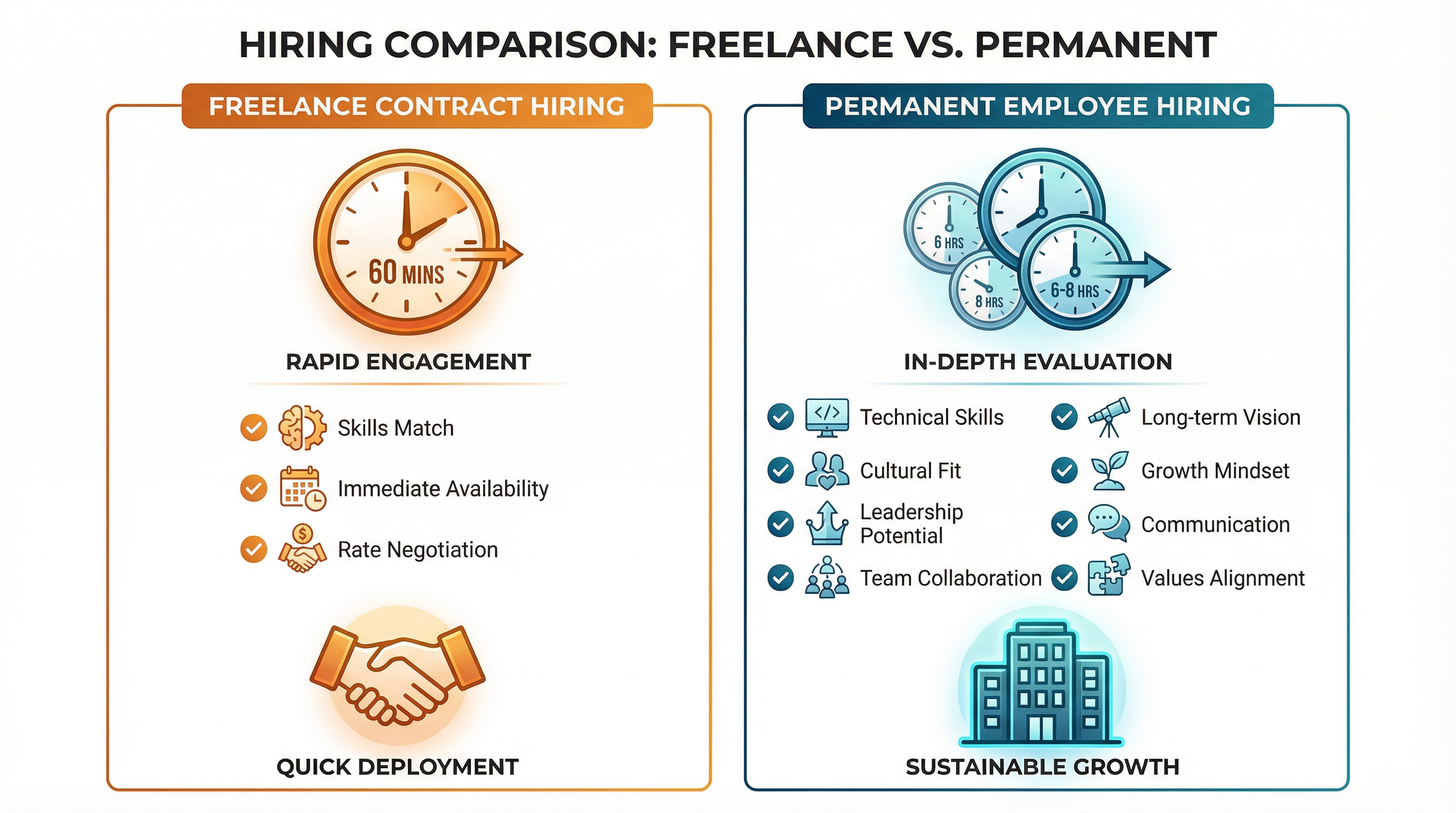
| Hiring Model | Primary Focus | Typical Evaluation Time | Key Criteria Evaluated | Ultimate Goal |
| Freelance/Contract | Immediate project needs | ~60 minutes (single interview) | Technical skills, availability, rate | Rapid deployment – fill a skill gap quickly for a specific task |
| Permanent/Full-Time | Long-term company growth | 6–8+ hours across 4–6 interviews | Technical skills plus cultural fit, leadership potential, team collaboration, long-term vision | Sustainable growth – invest in a high-impact, long-term team member |
As a freelancer, your value to clients is in your ability to parachute in and deliver a specific outcome with minimal hand-holding. The company cares that you can do X by Y date for Z cost – a clean transaction. As a permanent employee, however, your value extends far beyond the code you write on day one. It includes your ability to mentor junior engineers, contribute to the company’s culture, influence technical strategy, and commit to the organization’s long-term success. The hiring process is correspondingly extensive: it’s the company’s mechanism for de-risking a significant investment in talent.
Why so many hoops? Because a bad hiring decision in a full-time role is costly. The wrong hire can drag down team productivity and morale, or even jeopardize product quality and security. Research shows a single bad hire can cost a company at least 30% of that position’s annual salary (and potentially far more when you factor in recruitment costs, project delays, and lost opportunity). Companies mitigate this risk by evaluating candidates from every possible angle – technical aptitude, problem-solving approach, teamwork, leadership, and cultural alignment. It’s not paranoia; it’s prudent due diligence.
In practical terms, this means more interviews with more people. You’ll encounter not just the hiring manager, but also future teammates, cross-functional colleagues, and higher-ups. They’re all asking the question: “If we bring this person on board, will it be a long-term success for both sides?” This relational focus fundamentally changes how you should prepare. It’s time to switch from a contractor mindset (“I can do the job, here’s my rate”) to a partner mindset (“I’m invested in your mission, and here’s how I’ll grow it over time”).
The Four-Round Gauntlet: A Freelancer’s Roadmap to Success
Your journey to a permanent offer will likely involve four distinct interview rounds, each with a specific purpose and set of expectations. Think of it as a gauntlet designed to examine you from different vantage points. Understanding what each round is looking for (and how it differs from a quick freelance interview) is key to putting your best foot forward at every step. Here’s how to navigate them by anticipating what’s being assessed and framing your freelance experience as a strength at each stage.

Round 1: The HR & Culture Screen – Beyond the Resume
The Goal: This initial 30–45 minute conversation (often a phone or video call) with a recruiter or HR representative is a filter. It’s not meant to grill your coding skills; it’s about assessing your general fit and motivations before investing time in deeper interviews. The HR rep is confirming your basic qualifications, communication skills, and above all, your motivations for seeking a full-time role. They need to answer one critical question: “Why do you want to be a permanent employee now, after 20 years of freelancing?” If you can’t provide a compelling answer to that, the rest of the process may be moot.
What’s Being Assessed:
Motivation & Mindset: Are you running toward this full-time opportunity, or merely running away from freelancing? HR wants to see genuine enthusiasm for joining a team long-term, not just someone who is tired of hunting for gigs.
Communication & Attitude: Do you communicate clearly and professionally? Do you seem adaptable and positive? (They’re gauging how you might mesh with the company culture.)
Basic Role Fit: They’ll verify high-level things like your work authorization, willingness to relocate (if applicable), salary expectations, etc., to ensure none of these are deal-breakers. They’ll also check that your experience roughly aligns with the job description.
The Freelancer’s Trap: Offering a lukewarm or purely self-focused reason for wanting a full-time job. A common answer might be, “I’m looking for more stability.” While that’s an honest sentiment (who wouldn’t want a steady paycheck and benefits after years of variable income?), it’s a passive motivation. It frames you as someone seeking a safety net, not as someone eager to actively contribute value to the company. Remember, companies are not in the business of granting stability as a charity; they want to know what you will bring to them.
Another trap is coming off too transactional or contract-oriented in your tone. For instance, focusing on questions like contract length, overtime pay, side projects, etc., too early can raise concerns. The company might worry that you’re still thinking like a free agent rather than a committed team member.
Your Strategy: Craft a Proactive, Value-Focused Narrative
You must articulate a compelling story for why you’re making this career move, one that frames your freelance past as a strategic asset and positions you as excited to give to your next employer, not just get something from them. In other words, don’t focus on what you want to get (stability, benefits, etc.); focus on what you want to give in a full-time capacity.
Example – Bad vs. Good Answer:
Bad (Passive) Answer: “After 20 years of freelancing, I’m looking for a more stable role with benefits and a consistent paycheck.” – (This might be true, but it centers on your needs and implies you’re seeking comfort. It doesn’t tell the company why they should hire you for a long-term role, only why you want one.)
Good (Active) Answer: “Over my 20 years as a freelance engineer, I’ve had the privilege of solving a huge variety of technical challenges for diverse clients in fintech, e-commerce, healthcare—you name it. That breadth of experience has given me a big-picture perspective on what works and what doesn’t. Now I’m eager to invest that knowledge in a single product and team. I want to move beyond short-term fixes and contribute to a long-term architectural vision. I’m excited to mentor younger developers and help shape a technical roadmap over years, not just months. I was particularly drawn to [Company Name] because I love the work you’re doing in [Specific Area], and I can see myself dedicating the next chapter of my career to helping drive that forward.”
This kind of answer does a few important things: it reframes your freelance history as a plus (breadth of experience, adaptability), it signals a genuine desire for depth and long-term impact, and it flatters the company by showing you’ve done your homework on them. You’re not saying “I want a job because I need stability;” you’re saying “I choose your company because I believe I can add value and grow here.”
Additional Tips for Round 1:
Emphasize Collaboration: HR might be attuned to whether a long-time independent worker can thrive in a team environment. You could mention, for example, “Even as a freelancer, I found the best projects were the ones where I collaborated closely with in-house teams. I’m looking forward to being fully* part of a team and contributing to a shared mission.”*
Address the Elephant (if prompted): If they explicitly ask why no full-time roles for 20 years, don’t be defensive. Explain how freelancing was a deliberate choice that served you well (you honed certain skills, achieved variety, built a business), and now this is also a deliberate choice because you’re ready for something different (scale, stability of one project, leadership opportunities, etc.). Keep it positive – you’re adding a chapter, not closing one in defeat.
Show Long-Term Interest: You can drop subtle hints that you’re in it for the long haul. For example, ask a question at the end like, “How do people in this role typically grow over 3–5 years at the company?” This signals that you’re already picturing a future there, which is exactly what HR wants to see.
By the end of Round 1, you want the recruiter to think, “This candidate has their head and heart in the right place for a full-time role. They’d likely stick around and contribute.” Clear this bar, and you’ll move on to the more in-depth evaluations.
Round 2: The Technical Deep Dive – Proving You’re More Than a Hired Gun
The Goal: Now it’s time to face the hiring manager (e.g. CTO, Engineering Manager, or Lead Developer). This round often runs 60–90 minutes and is akin to what might be an entire interview in a freelance hire—but with the volume turned way up. The assumption here is that you obviously can code (your resume and Round 1 got that far). What they’re really probing is your engineering depth and architectural thinking. They want evidence that you’re not just a coder who takes orders, but someone who can design systems, make high-level technical decisions, and keep up with modern engineering practices. They are looking for signals of technical leadership: can you not only execute, but also plan, architect, and guide others?
What’s Being Assessed:
System Design & Architecture: Expect a system design exercise or discussion. They might say, "Let’s design a simplified version of Twitter," or "How would you architect an e-commerce system at scale?" The aim is to see how you handle open-ended problems and if you understand the trade-offs in software design (scalability, consistency, security, etc.).
Depth of Experience: They’ll dig into your past projects. But unlike a freelance interview that might just verify "did you use tech X to do Y?", here they want the why and how behind your technical choices. They may ask you to walk through a complex project architecture you built, challenges you overcame, and how you collaborated with others on it.
Breadth of Modern Knowledge: Your ability to discuss current technologies, frameworks, and tools matters. They might not quiz you on syntax, but they could gauge if you’re up-to-date.
Problem-Solving Approach: Some roles still include a live coding component or algorithmic problem here. But for a senior engineer/lead role, it might be more discussion-based or reviewing code rather than a LeetCode-style quiz. They want to see how you think aloud, how you approach unfamiliar problems, and whether you write clean, logical code when needed.
Leadership in Tech: If this role is for Lead Engineer, they’ll also evaluate how you’d mentor others technically. They might ask how you review code, how you handle disagreements on architecture in the team, etc.
The Freelancer’s Trap: Talking only about specific technologies and tasks as if checking off a list, rather than demonstrating conceptual understanding. Freelancers often bounce between projects with different tech stacks, which is great, but if you just rattle off "I’ve done React here, Node there, Python there," it can pigeonhole you as a utility player who follows client specs, rather than a technologist who drives decisions. Another trap is underestimating the importance of design and architecture questions—focusing too much on what you built instead of how you design systems.
Also, be careful of coming across as a solitary problem-solver. Saying "I just went off and solved X on my own" for every project might make them wonder if you can integrate into a team that requires consensus and collaboration on technical direction.
Your Strategy: Demonstrate Architectural Ownership & Vision
Show You’re a System Designer, Not Just a Coder: Be prepared for that system design question and embrace it. This is your chance to shine by drawing on your broad experience. When asked, for example, to design a mini Twitter, don’t jump straight into a single tech stack you used before. Instead, discuss high-level components: "We’d need a service for tweets, a service for timelines, maybe use a distributed queue for fan-out to followers…". Talk through trade-offs: SQL vs NoSQL for storing tweets, monolithic vs microservices architecture, REST API vs GraphQL for the client, etc. Justify your decisions based on requirements.
Connect Your Stories to Business Impact: When discussing past projects, go beyond what you built and explain why you built it that way. Did your design improve the system’s performance by 30% or cut cloud costs by 15%? Quantify results if possible.
Show You’re Current (Subtly Address the Age Factor): The tech industry has a well-documented ageism problem. One study found that while 57% of CS grads are still programmers six years out of college, that number plummets to just 19% by their early 40s [3]. At 44, you must proactively counter the stereotypes by weaving in references to recent technologies, continuous learning, and modern practices (CI/CD, IaC, observability).
Team Technical Leadership: Be ready for questions about guiding a team technically. Show you can lead without steamrolling, and that you use facilitation and design reviews to reach consensus.
By the end of Round 2, you want the hiring manager to be convinced that “This person can handle our toughest technical challenges, and elevate the team’s engineering practices.” In their eyes, you should transition from “hired gun” to “potential tech lead.”
Round 3: The Team Collaboration Round – Are You a Partner or a Solo Act?
The Goal: Culture fit and collaboration are front and center here. This round typically involves meeting your potential peers. They’re asking: "Can we work with this person every day? Would we trust them and enjoy having them on the team?"
What’s Being Assessed:
Teamwork & Communication: Do you listen, ask good questions, and communicate respectfully?
Problem-Solving in a Group Setting: Pairing, co-design, and how you incorporate feedback.
Mentorship & Empathy: Are you a mentor or a know-it-all?
Cultural Fit: Attitude, humility, curiosity.
The Freelancer’s Trap: Projecting an aura of "I know best." Over-indexing on “I” language, dismissing junior devs, or sounding overly transactional.
Your Strategy: Showcase Humility, Empathy, and Team Spirit
Use “We” Language and acknowledge collaboration even when you were the primary driver.
Ask Before You Tell: “What have you tried?”, “What are the constraints?”
Share a Story of Fallibility: A time you were wrong and what you learned.
Mentor + Learn: Demonstrate you lift others up while staying curious.
By the end of Round 3, you want your peers to think, “We’d love to have this person on the team.”
Round 4: The Leadership & Vision Round – Proving You’re a Long-Term Investment
The Goal: Final round with a VP/CTO/CEO. They’re asking: “If we hire you, what will you do for us over the next 3–5 years? Are you worth betting on?”
What’s Being Assessed:
Long-Term Vision: Alignment with product and business direction.
Leadership & Initiative: Ownership beyond IC tasks.
Commitment & Values: Likely tenure, alignment, integrity.
Executive Communication: Can you connect tech to business outcomes?
The Freelancer’s Trap: Thinking short-term (project-to-project). Not researching the company. Asking only tactical questions.
Your Strategy: Think and Speak Like a Future Company Leader
Do Your Homework – Then Show It: Reference product launches, strategic moves, market challenges.
Articulate a 3–5 Year Story: Tie your growth to the company’s growth.
Frame Age as an Asset: Stability, perspective, mentorship, and long-term commitment.
Ask Big-Picture Questions: Strategy, roadmap, engineering culture at scale.
By the close of Round 4, you want leadership convinced that hiring you is an opportunity, not a risk.
Conclusion: You’re Not Starting Over – You’re Leveling Up
The leap from a 20-year freelance career to a full-time role can feel like a different game. But you’re not a beginner—you’re a veteran adapting to a new arena. The key is to translate your freelance experience into signals that full-time hiring managers value: long-term commitment, team collaboration, leadership, and alignment with mission.
You are not just a coder for hire. You are a seasoned problem-solver, an adaptable technologist, and a potential mentor who has seen cycles of technology and business. With the right narrative, preparation, and mindset for each interview stage, you can turn your unique path into your strongest differentiator.
Embrace the process, tell your story with confidence, and prepare to make a lasting impact—together.
References
[1] Upwork. (2025). The Future Workforce Index: Evolving Talent Trends in 2025 and Beyond. https://www.upwork.com/research/future-workforce-index-2025
[2] Exponent. (2024). Get a Job in Tech: Interview Process and Prep. https://www.tryexponent.com/blog/tech-interview-process
[3] Abduldattijo. (2025). Ageism in Tech: Career Longevity Reality for 40+ Engineers. Medium. https://medium.com/illumination/ageism-in-tech-career-longevity-reality-for-40-engineers-aa79b6fd8b08